With the right tools, you can change your child’s life. Your child can overcome their learning reading problems whether they have dyslexia, an identified learning disability, are falling through the cracks, or are even gifted.
You know how painful it is to see your child struggle or take forever to read their assignments. Reading comprehension is hard. Reading fluency is almost non-existent. You just want to take that pain away. You so want to see your child read with ease. I’m here to tell you, reading doesn’t have to be so hard!
Watch what Nancy Hogan has to say about how her daughter got help with her reading problems.
The 3 Roadblocks to Learning Reading
-
Learning Reading: Phonics Related Problem
Phonics related reading problems are when your child ‘jumbles’ or mispronounces the words as they are trying to decode(the ability to sound out printed words) or encode (the ability to put letters to the sounds that make up a word). You have no idea what the word is that they are trying to read until you look at it yourself. -
Learning Reading: Reading Fluency/Visual Tracking Problem
When it takes your child what seems like forever to read the sentence or they have skipped, omitted or repeated words when reading. -
Learning Reading: Lack of Language or Vocabulary Problem
This prevents comprehension or being able to understand what you read.
The Story Behind Discovering the Roadblocks to Learning Reading
I’ve been there. No one knows more than I do the pain of being a slow reader. In fact, when I was in the 3rd grade I was in the Bluebirds reading group. And my reading group was the lowest group. Everyone knew the Cardinals were the best readers in the class. It was No Secret, even though no one had actually told me.
With a lot of help from my mom and teacher, my reading improved and I went on to college to become a learning disabilities specialist. I went into this field because I knew the pain reading difficulties caused and I knew that doing things differently could make a difference. My entire future was changed when I became a proficient reader.
Years later, I had my own children. They were all bright, in fact, they tested to be gifted, but reading was hard for one of my kids. He really didn’t like to read. He struggled with every reading assignment. That really frustrated me, being a specialist, spending my life helping kids to improve their own reading, and one of my sons had a hard time with it.
Homework time often becomes a nightmare
It was a battle of wills. I was hard pressed to NOT just give the answers to my son so that ‘homework time’ could be over. My stomach used to tighten up every August 1st, knowing that the homework battles would be starting soon due to the difficulties my son had with reading.
My son would skip, miss, or repeat words as he read. This made him miss bits and pieces of the text while he read. And, when he got to the comprehension questions, they didn’t make any sense to him. By the time he was in the 7th grade he flung his social studies book at me saying, “Mom, I’ve read this 5 times and I still can’t find the answer. You do it.”
Over my years as a learning disabilities specialist and board certified educational therapist, I’ve worked with every type of reading problem, learning disability, and dyslexia imaginable. I have spent thousands of hours working with students in the classroom, with teachers, and with parents to develop solutions to reading problems. In fact, I’ve found that reading problems can be grouped into three broad categories, phonemic awareness/phonics, fluency and vocabulary/text comprehension.
4 Solutions to the 3 Most Common Learning Reading Roadblocks
The Reading Pack
During my first 25 years of working with thousands of children, teachers, and parents I started developing 4 different teaching materials to use to address the three different problems that children, teens, or adults face when they have a reading problem. Then the materials were used in the classroom and in homes for five more years, so I could get feedback on the materials.
After several years of being asked by hundreds of teachers and parents where they could get the materials I used I finally decided to copyright and print the materials that were making the difference in my student’s lives to make them available to everyone.
I used 4 different materials to teach my students to read with ease because reading has several components that are interrelated. Let me explain. If you think of your body, you have arms that can move different ways. You have legs that do other kinds of movements. You have eyes that see. You have ears that hear. And you have a brain that sends messages throughout the body. Each part can function independently, but when all of the parts are working together, you have a well functioning body.
Reading is like that. For example, spelling is related to phonemic awareness and phonics, because when you spell a word you typically ‘sound’ it out. The ability to take notes, write summaries, reports, and paragraphs is directly related to being able to understand the words you have read. If you don’t understand what you have read you will not be taking good notes or retaining the information read. You will have trouble summarizing the information.
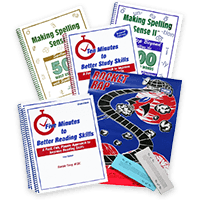
The ability to be a fluent reader is related to being able to decode words effortlessly as well as track the words from left to right with ease. This is the ability to read fast enough to be able to hold the ideas you are reading in context rather than holding a word at a time and losing the meaning. There is an inner connection to all of these skills. Because of this inner connection, I’ve bundled the 4 materials that address reading problems into the Reading Pack.
Solution 1: Spelling by spelling pattern to address
Phonics, Encoding, and Decoding Roadblocks
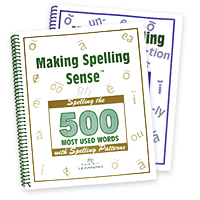
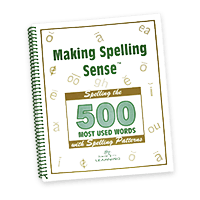
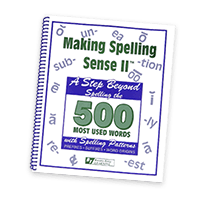
Making Spelling Sense™ and Making Spelling Sense™ II
I always start with spelling when teaching reading. You can’t read if you can’t sound out words. Learning how to sound out words (word attack skills) and how letters/sounds are put together to make words is spelling. Spelling is the direct connection between phonics, decoding, and encoding. You won’t be a fluent reader if you can’t decode words quickly.
When you are trying to spell a word you usually sound it out as you are spelling it and then check it over once you’ve written it down. That process is encoding. When you come upon a word you don’t know you usually try to sound it out. That is decoding. So working with words whether you are encoding or decoding them, you are actually working with spelling. This directly affects your reading fluency.
You know what it’s like when your child comes home from school each week and needs to get ready for another spelling test. You quiz them on the words, because that is what your parents did when you were learning. You might even have your kids write their spelling words down a few times to help them remember them. And often they come home upset because they didn’t do well on the spelling test.
When I started teaching spelling I did what every other teacher did, I used the spelling books that were provided. The problem was that there didn’t seem to be any rhyme or reason for the words on each list to actually ‘go together’. My kids had to memorize every single word. Even my daughter, who was gifted, had trouble memorizing her spelling words.
Then I found a program where you taught spelling a sound at a time. This worked a bit better. But, I was still looking for a better solution. Eventually I went to a seminar on spelling and found that we only put letters together 8 ways to make words.
This was incredible, after years of teaching to finally discover that we only put letters together 8 ways to make words! I knew that my kids with poor memory skills could learn how to spell if they didn’t have to memorize every single word! Remembering 8 patterns would be so easy in comparison.
So I did what every good teacher does, I put my kids through both spelling programs. The problem now was teaching spelling was taking twice the time it should have to. So I decided to combine the methods and use the 500 most frequently used words for the word lists.
The result of this was Making Spelling Sense™. By combining the methods I really wanted to get a lot of ‘bang’ for my and my student’s time. So, the spelling program actually was a real solution to teaching phonics, teaching my students how to decode and encode words at the same time as learn the 8 spelling patterns, a pattern at a time.
Now, as a parent, you can have the code, the 8 ways we put letters together to make words and teach the patterns to your child with story explanations in a step-by-step method. Your child will know the code and know how to sound out words and spell thousands of words.
Solution 2: Quick and short reading drills to address Reading Fluency and Visual Tracking
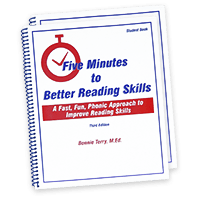
Five Minutes to Better Reading Skills™
You know how difficult it is to listen to your child falter when reading or take forever to get the words out of their mouth, or skip words or whole lines when they are reading. And yet you know you need to have them practice in order to become a better reader. You’ve probably heard something about reading fluency so you know it must be important even if you’re not quite sure what it is or what to do to improve your child’s fluency.
I found out about fluency during my first year of teaching in 1973 when I was an itinerant learning disabilities teacher. A teacher who was retiring showed me some reading drills she used with her struggling readers and she suggested that I use them with my students. These drills were in a folder at this point, with many of the pages torn and tattered. I did use them with my students and their reading fluency really improved.
After moving across the country and having my own kids, I no longer had these drills. I searched and searched but could not find anything like them. The thing I remembered that was so great about them is that they only took a few minutes a day and my students made great progress with them.
Since I couldn’t find the drills anywhere I spent years trying out other fluency programs. I wasn’t satisfied with any of them. They just didn’t address the needs of my kids that were not fluent readers and also had visual perception problems.
I knew I had to do something about my kids fluency because fluency is the component that forms the bridge, makes the connection, between decoding and comprehension. Without fluency meaning in text is lost. Unfortunately fluency is one of the most neglected reading skills.
I decided that the only thing to do was to design my own drills that would address the reading fluency problems as well as visual perception problems at the same time. I developed Five Minutes to Better Reading Skills.
Sally Shawitz, M. D. states in her book Overcoming Dyslexia, “I urge parents of dyslexic children (or any child) to make fluency training – repeated oral reading – their number one priority. Because it involves reinforcement rather than teaching a child a new concept, it is ideally suited for the home.”
Debra Wilson, Reading Specialist and author from Redding, CA states, “We did a five year study using Bonnie Terry’s Five Minutes to Better Reading Skills™ and the reading fluency of kids in our school district improved dramatically.”
You know what it is like trying to juggle school, sports, homework, and family time. I knew many of my students wouldn’t sit still for long periods of time to work on reading, especially when it was hard for them.
This system incorporates visual tracking and other visual processing activities into short 5-minute fluency practice sessions.
You might be thinking to yourself that five minutes isn’t long enough to make a difference in your child’s reading. However, a recent study by the University of Florida states that fluency practice can last for as little as five or six minutes a day and you’ll have substantial gains. It’s the daily fluency practice that makes the difference.
So why not try something different? You have nothing to lose and so much to gain!
Your child doesn’t have to be the last one finished with their reading assignment anymore. Their skills can improve tremendously with short 5-minute sessions.
Solution 3: A set of tools to address
Reading Comprehension and Writing Roadblocks
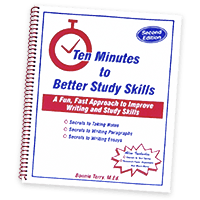
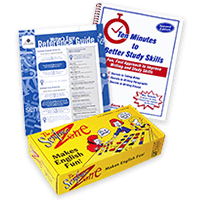
Ten Minutes to Better Study Skills™
What does writing have to do with reading? Every week or two your child comes home with a writing assignment of some sort that is related to reading. First they have to read a selection and then they need to write something from the selection, whether it is short answers to questions, a paragraph summary, or a full-fledged report. They actually had to understand what they read, the vocabulary and language of it e.g.: new vocabulary words, science terms, or social studies facts. Being able to pull out the important information of what you read, understanding what you read, is directly related to being able to write with ease.
This is HARD for many children. For them it is like having their teeth pulled without the Novocain. My own kids’ reaction to any writing assignment was to stare at blank sheets of paper, totally frozen, not knowing what to write.
You know that to have accurate comprehension, you need to be able to utilize the information that you read. And, you need to be able to communicate with others about what you read. One of the ways to do this is to be able to write about what you have read.
So, after years of trial and error, attending numerous seminars, and research from the National Reading Panel, I realized the solution was to use graphic organizers.
When my students had writing assignments, they brought in the notes they had done at school. Their notes were done with a webbing method. The webbing method of note taking uses the size of circles to indicate the importance of ideas and connecting lines to indicate relationships. Typically the main topic is in the center with a large circle. Then important supporting ideas have slightly smaller circles and the less important ideas have the smallest circles. Lines from one circle to another indicate that the concepts in the connected circles are related in some way.
The problem was that although those students could do the webbing assignment while in class, when they went to actually use the web format to write from, they were stuck, frozen again. This was because their notes were all over the place – coming out in many circles just like a spider web. They couldn’t get focused on what was important and what the connections were.
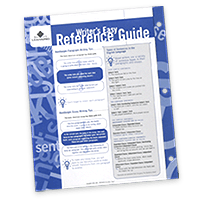
I knew there had to be a better way for my kids to be able to take notes and then actually be able to utilize them. So I developed numerous graphic organizer fill-in-the-blank note taking, paragraph writing, and essay writing forms that were designed with the end use in mind. My students would be able to not only take the notes, but they would also be able to use their notes to write a paragraph or essay from them. Now they didn’t have to stare at blank sheets of paper. They would be able to pull out the important information from what they read and then use the graphic organizers and fill-in-the-blanks. Their stress level came down, and they were able to write for the first time, and actually be successful!
Now you have the opportunity to make your child’s writing assignments easy for them. They don’t need to sweat and struggle through another writing assignment. You don’t have to sweat and struggle through your child’s writing assignments any longer either!
Solution 4: A reading game to address Reading Comprehension and Listening Comprehension Roadblocks
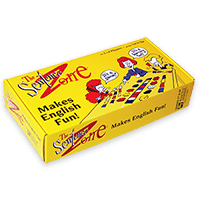
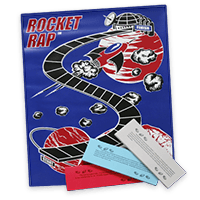
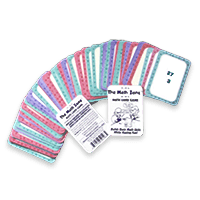
The Comprehension Zone™: Rocket Rap™
Do you ever watch your child take notes from what they are reading or read the notes they have taken and wonder why in the world they write that note and miss the important part of the passage? Were they just writing anything down so they could say they were finished? Did they even think about it?
Sometimes my children and my students weren’t sure about which notes to write in the graphic organizer fill-in-the-blank forms. Sometimes they put in a very small detail and left out the most important fact. For instance, they would put down that Jupiter has a ring of dust around it and miss that it is the biggest planet. Or that Washington cut down the cherry tree and didn’t tell a lie but miss that he was the first president.
To help them to become really good note takers, I realized they needed practice with finding the main idea as well as supporting details. I knew that they would really get good at this skill if they had a lot of modeling and practice. So I developed a comprehension game where they would get a lot of practice with both reading comprehension and listening comprehension.
In fact, research from the Center for Research on Learning developed a strategy called the Paraphrasing Strategy to improve reading comprehension. The way The Comprehension Zone™ is played is supported by their research.
The game format helped my kids learn how to read for meaning while they played a game. The object of the game is to either find the main idea, the details, both of those, or to sequence what they had read.
Being able to play a game while learning those reading comprehension skills really helped improved the quality of their note taking and writing.
Do yourself and your child a favor, don’t let another week go by where reading and writing is hard for them. Every week you delay is another week that your child is frustrated, falling further behind, and losing self-esteem. There is no magic pill, but spending a little bit of time each day with the correct materials will make a significant difference in your child’s life and in your family’s life too!
Your child can get to the point where they really enjoy reading and writing. You can even come home from work and find them reading a book just for fun. The key is to act now.
10 Free Homework Tips
Simply enter your information into the form below: