- Is your child struggling every week with their spelling lists?
- Do you get frustrated trying to help them with their spelling assignments?
- Does your child apply the spelling they have learned to actual writing assignments?
- Do you wonder if there is an easy way to help your child remember how to spell?
Spelling Really Can Be Easy!
Many children and adults struggle with how to learn to spell. In fact, even gifted children sometimes struggle with learning how to spell. Your child does not have to have a learning disability to have problems with spelling. Any child can be overwhelmed with spelling.
- Can you imagine spelling not being hard for your child?
- Can you imagine the day you read their writing assignment and you understand words they wrote because they didn’t misspell them?
- It can happen!
You can learn to spell with ease when you understand the 8 ways we actually put letters together to make words.
Learn to Spell: Spelling Defined
Spelling is closely related to phonics and the word attack skills of encoding and decoding. In fact, there is a direct connection between spelling, phonics, decoding, and encoding.
When you are learn to spell a word you usually sound it out as you are spelling it and then check it over once you’ve written it down. That process is encoding. When you come upon a word you don’t know you usually try to sound it out. That is decoding. So working with words whether you are encoding or decoding them, you are actually working with spelling. When you improve your ability to learn to spell, (encoding and decoding) improves, reading improves.
You know what it’s like, each week your child comes home from school and has to get ready for another spelling test. You quiz them on the words, because that is what your parents did when you were learning. You might even have your kids write their spelling words down a few times to help them remember them. And often they come home upset because they didn’t do well on the spelling test.
- The Roadblocks
Auditory and Visual Processing are critical to learn to spell -
The Secret
8 Spelling Patterns, Auditory, Visual, and Tactile methods. -
The Solution
A complete method that solves spelling problems teaching you the eight spelling patterns with audio, visual and tactile methods.
Learn to Spell: The 6 Roadblocks to Spelling
These learn to spell roadblocks affect two processing areas which are critical to encoding and decoding words
Learn to Spell: Auditory Processing
-
Auditory Discrimination
Difficulty recognizing the difference between sounds. (Some children have trouble telling the difference between the short e sound and the short i sound.) -
Auditory Closure
Where you have a hard time pulling sounds together to form a word or trouble filling in gaps when they miss parts of words or conversations. -
Auditory Visual Integration
Trouble putting the correct letter with the sound.
Learn to Spell: Visual Processing
-
Visual Discrimination and Form Constancy
Problems determining whether similar words are the same or not as well as whether letters within a word are the same. This is particularly true with the letters b, p, d, and q. -
Visual Memory
Trouble remembering what the word is or remembering once it is written if it is spelled correctly. (i.e. thinking a word doesn’t look like it was spelled correctly) -
Visual Closure
Difficulty pulling the sounds of words together into a complete word. For instance, if you read cat as cat, you will typically spell it either cat or kat. That is where the visual memory comes into play. You would look at kat and realize it is wrong. If you read the word as cuh a-a-a tuh, you could end up misspelling the word.
I had a student who knew each sound the letter could make, but by the time he got through 3-4 letters he couldn’t hold all the sounds to blend them (auditory memory skill). So for him a word like book was like this ba oew ew ca but could never come together to be book This obviously made it difficult for him to remember how to spell the word book.
Over the years working with my students, I’ve found that most of those that had a difficult time spelling usually had some sort of an auditory or visual processing difficulty. Often the problem isn’t even one you would see the schools address because it isn’t enough of a problem to warrant intervention. It is only one that makes for ‘poor’ spelling for your child. So I knew I needed to teach spelling with some sort of a system that would address the auditory problems.
Learn to Spell: The Secret
I started using a process to teach my students to learn to spell with the sounds of the letters and my students started to improve. But they got to a certain point and then they were stuck again. So I continued to search for a better way. When my daughter was in the 6th grade I attended a seminar and came across the secret, the 8 patterns we use to put words together.
Once I discovered the 8 patterns, I used that knowledge along with the sound system for teaching spelling. But I was using twice the time to teach it, so I finally decided that I needed to combine the processes and developed a way to put the patterns together in an auditory, visual, and tactile method to teach spelling. This special way of teaching spelling then became one where the underlying cause of spelling problems is addressed at the same time as teaching the structure of the English language (8 patterns).
Learn to Spell: The Solution
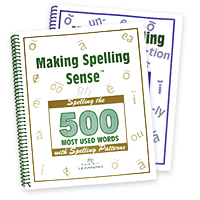
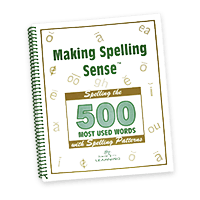
After 30+ years of developing my learn to spell program with students, teachers, and parents, and taking time to perfect it, hundreds of requests from teachers and parents came in. They all wanted to use the system I had developed. So, I wrote my method down and created Making Spelling Sense.
With it, your child can become a good speller and learn to spell over 500 of the most frequently used words in the English language. By using this step-by-step method, your child will be able to spell thousands of words.
Using visual, auditory, and tactile modes of learning, your child is sure to learn. It is phonetically and sequentially based. In addition to teaching spelling, it also teaches your kids how to decode (sound out words) and encode (put letters to the sounds that make up words).
It also strengthens visual perception through the puzzles and other exercises that are provided. There is a structure to the English language, and if we teach spelling according to the structure, everyone can spell!
Read more about Making Spelling Sense
Learn to spell with Making Spelling Sense II
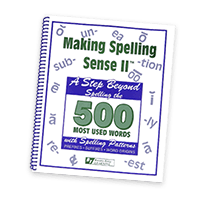
After my students completed Making Spelling Sense, I started teaching them about prefixes, suffixes, and root words. Numerous teachers and parents wanted to go one step further and asked me what to do and could I just write the sequel. So, I created Making Spelling Sense II.
I developed Making Spelling Sense II at the request of hundreds of teachers and parents. They wanted a spelling program they could use with their older students that would teach them the spelling patterns as well as get into more advanced topics such as prefixes, suffixes, root words, and word origins.
Making Spelling Sense II is a step beyond the 500 most used words. Children learn to spell the most frequently misspelled words, words with prefixes, suffixes, root words, and word origins. Making Spelling Sense II also uses a step-by-step method with the eight basic spelling patterns of the English Language with visual, auditory, and tactile methods of learning.
Read more about Making Spelling Sense II
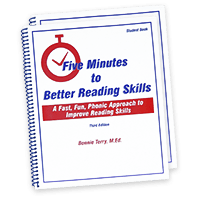
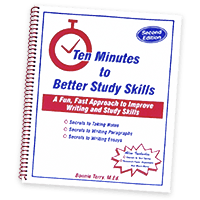
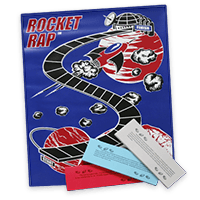
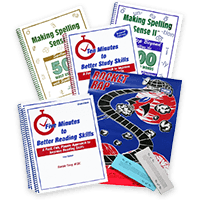
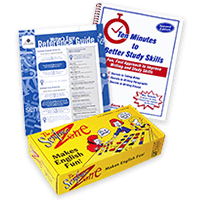
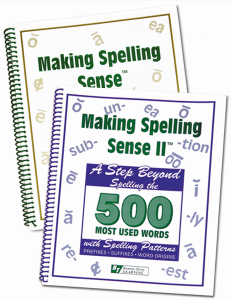
Remember when you learn to spell you directly impact your reading skills for the better. Get the tools you need to address your child’s underlying reading problems. Get Making Spelling Sense, Making Spelling Sense II, Five Minutes to Better Reading Skills, Ten Minutes to Better Study Skills, and The Comprehension Zone: Rocket Rap all in the Reading Pack.
Continue to the Reading Pack